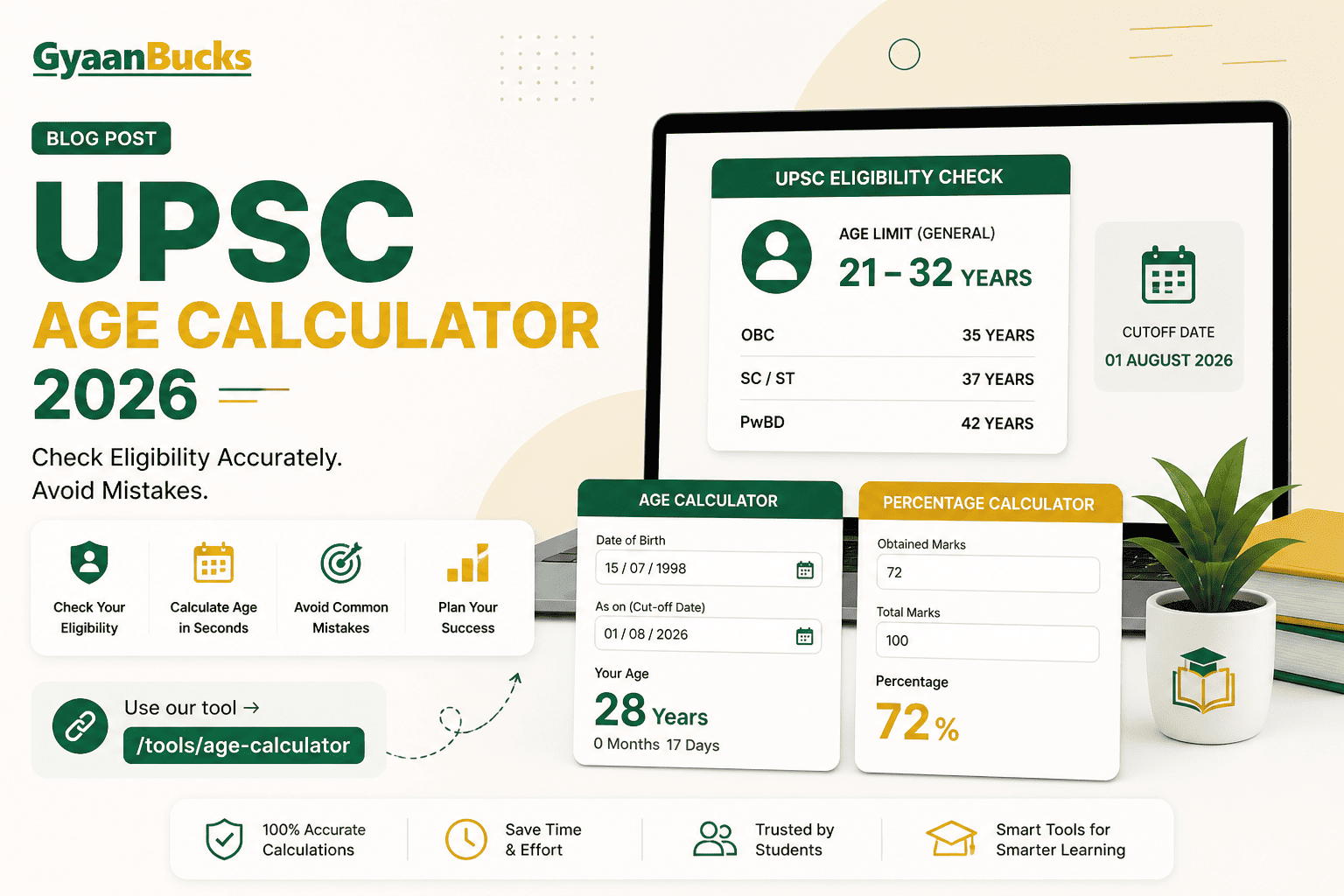
UPSC Age Calculator 2026: Check Your Eligibility Easily & Avoid Common Mistakes
Preparing for the Civil Services Examination conducted by Union Public Service Commission (UPSC) is a long journey. Many students focus only on syllabus and preparation, but one important thing often gets ignored — age eligibility.
Every year, thousands of aspirants get confused about whether they are eligible or not. This happens mainly because they don’t calculate their age correctly based on UPSC rules.
That’s why using an UPSC Age Calculator is one of the smartest things you can do before starting your preparation.
In this guide, we will clearly understand how age calculation works, how to calculate it manually, and why online tools are much better.
What is an UPSC Age Calculator?
An UPSC Age Calculator is a simple online tool that calculates your exact age based on your Date of Birth (DOB) and the official UPSC cutoff date.
Instead of guessing your age, this tool gives you:
- Exact age in years, months, and days
- Eligibility confirmation
- Accurate results within seconds
👉 Use our Age Calculator Tool to check your eligibility instantly
UPSC Age Limit for 2026 (Expected)
The age criteria for UPSC generally stays consistent every year.
Basic Eligibility:
- Minimum Age: 21 years
- Maximum Age: 32 years (General Category)
Age Relaxation:
Category Maximum Age
General 32 years
OBC 35 years
SC/ST 37 years
PwBD Up to 42 years
📌 Important:
UPSC does NOT calculate your age based on today’s date. It uses a specific cutoff date, usually August 1 of the exam year.
Why Correct Age Calculation is Important
Many aspirants assume their age incorrectly and face problems later.
Real-Life Example:
Let’s say:
- DOB: 5 August 1994
- Cutoff Date: 1 August 2026
You might think:
“I turn 32 in August, so I am eligible.”
But actual calculation:
👉 On August 1, 2026, you are still 31 years + 11 months So you are eligible.
Now imagine the reverse mistake — you might think you are eligible, but actually cross the age limit.
That’s why precision is very important.
How to Calculate Age Manually:
Manual age calculation is possible, but it requires careful steps.
Step-by-Step:
- Take your Date of Birth
- Take UPSC cutoff date (e.g., 1 August 2026)
- Subtract DOB from cutoff date
Example:
- DOB: 12 February 1997
- Cutoff: 1 August 2026
Calculation:
- Years: 2026 - 1997 = 29
- Adjust months and days
Final Age:
👉 29 years, 5 months, 20 days
Problems with Manual Calculation
Even though manual calculation looks simple, it has many issues:
- Month and day adjustment is confusing
- High chance of mistakes
- Time-consuming
- Not practical for repeated use
That’s why most students prefer online tools.
Benefits of Using an Online Age Calculator:
Using an online calculator gives you multiple advantages.
1. Instant Results
You get your exact age within seconds.
2. 100% Accuracy
No human error in calculation.
3. Easy to Use
Just enter DOB and select cutoff date.
4. Useful for Multiple Exams
You can use the same tool for:
- UPSC
- SSC
- State Government Exams
👉 Use our best calculators for free.
What is a Percentage Calculator?
Along with age, students also need to calculate percentages frequently.
A Percentage Calculator helps you calculate:
- Exam marks
- Accuracy percentage
- Performance analysis
👉 To use percentage-calculator
Percentage Calculation Formula
Here is the standard formula:
Percentage=Obtained MarksTotal Marks×100\text{Percentage} = \frac{\text{Obtained Marks}}{\text{Total Marks}} \times 100Percentage=Total MarksObtained Marks×100
Example:
- Marks: 85
- Total: 100
Result:
👉 85%
Common Mistakes in Percentage Calculation
Students often make small mistakes that affect their analysis.
1. Using Wrong Formula
Some people calculate incorrectly:
Wrong:
Total ÷ Obtained × 100 ❌
Correct:
Obtained ÷ Total × 100 ✅
2. Ignoring Negative Marking
In competitive exams, wrong answers reduce marks.
Always calculate final marks before percentage.
3. Rounding Errors
Example:
- 66.666 → Rounded to 67 ❌
- Correct → 66.67 ✅
Benefits of Online Calculators for Students
Online tools are not just time-saving — they improve your preparation quality.
1. Saves Time
No need for manual calculations.
2. Reduces Errors
Accurate results every time.
3. Helps Track Progress
You can monitor your improvement.
4. Multi-Purpose Usage
Useful in:
- Exams
- Daily calculations
- Career planning
Manual vs Online Calculation
Feature Manual Online
Speed Slow Instant
Accuracy Error-prone Accurate
Effort High Very Low
Use Limited Multiple
👉 Clearly, online tools are better.
Real-Life Use Cases
1. Government Exam Eligibility
Check eligibility for UPSC, SSC, and others.
2. Academic Performance
Calculate marks and percentages.
3. Everyday Life
Use for:
- Age verification
- Document filling
- Planning goals
Internal Linking Suggestions (For SEO)
Add these links inside your blog:
- /tools/age-calculator
- /tools/percentage-calculator
- /quizzes
- /profile
This improves SEO and user engagement.
FAQs
1. What is the UPSC age cutoff date?
Usually, it is August 1 of the exam year.
2. Can I rely on manual calculation?
You can, but it is risky due to errors.
3. Does UPSC provide age relaxation?
Yes, based on category (OBC, SC/ST, PwBD).
4. Why is my age different in official calculation?
You may be ignoring:
- Cutoff date
- Month/day calculation
5. Are online calculators safe?
Yes, they are reliable and widely used.
Final Thoughts
When preparing for UPSC, every small detail matters. Age eligibility is one such detail that many students ignore until it’s too late.
Instead of guessing:
- Use an Age Calculator to check eligibility
- Use a Percentage Calculator to track performance
These simple tools can save you from mistakes and help you stay focused on your preparation.
👉 Smart students don’t just study hard — they use smart tools.
Start earning with quizzes
Play quizzes daily, improve your knowledge, and earn reward points on GyaanBucks.
Start Playing Now